I'm Gillian, a Scotland based home & lifestyle blogger. Follow along as I navigate this new journey sharing my life from home.


There’s a particular kind of Christmas table that doesn’t try to reinvent anything. No new colour trend, no minimalist white-on-white scheme, just red and green with gold running through it, the way Christmas tables have looked for decades. That’s the table I wanted this year, and it turned out to be the easiest one I’ve ever put together.
A big part of that came down to one lucky charity shop find: a vintage tablecloth in exactly the reds and greens I needed. Everything else followed from there.
Why traditional colours still work
Red and green get written off as predictable, but there’s a reason they’ve stayed the classic Christmas combination for so long. They’re warm, they photograph beautifully in low light, and they don’t need any explanation. Nobody walks into a room dressed in red and green in December and wonders what the theme is.
Gold is what stops it tipping into overly bright or childish. A gold charger, a brass candlestick, a few gold ribbon details, and the whole thing reads as considered rather than costume-y. The trick with traditional Christmas colours isn’t avoiding them, it’s choosing the right shades and finishes so the scheme feels rich rather than primary.
Start with a good base layer
The tablecloth or runner sets the tone for everything that follows, so it’s worth taking your time over. Vintage cloths, whether from a charity shop, a family member, or an antiques fair, tend to have a depth of pattern and colour that new ones rarely match. Look for cloths with a mix of red, green and a metallic thread running through them, since that gives you a base that ties in gold accessories without needing to match anything else exactly.
If you can’t find a vintage option, a plain cloth in a rich green or deep red works just as well as a starting point, and lets your tableware do more of the visual work.
Layer your tableware rather than matching it exactly
The most traditional-looking tables are rarely made from a single matching set. Mine layers gold chargers underneath a set of Christmas-patterned plates, with green transferware dishes mixed in on top. None of it was bought as a set, and that’s exactly why it works. A table built entirely from one matching dinner service can look flat. Layering different patterns and pieces, as long as they share a colour thread, gives the table texture and history.
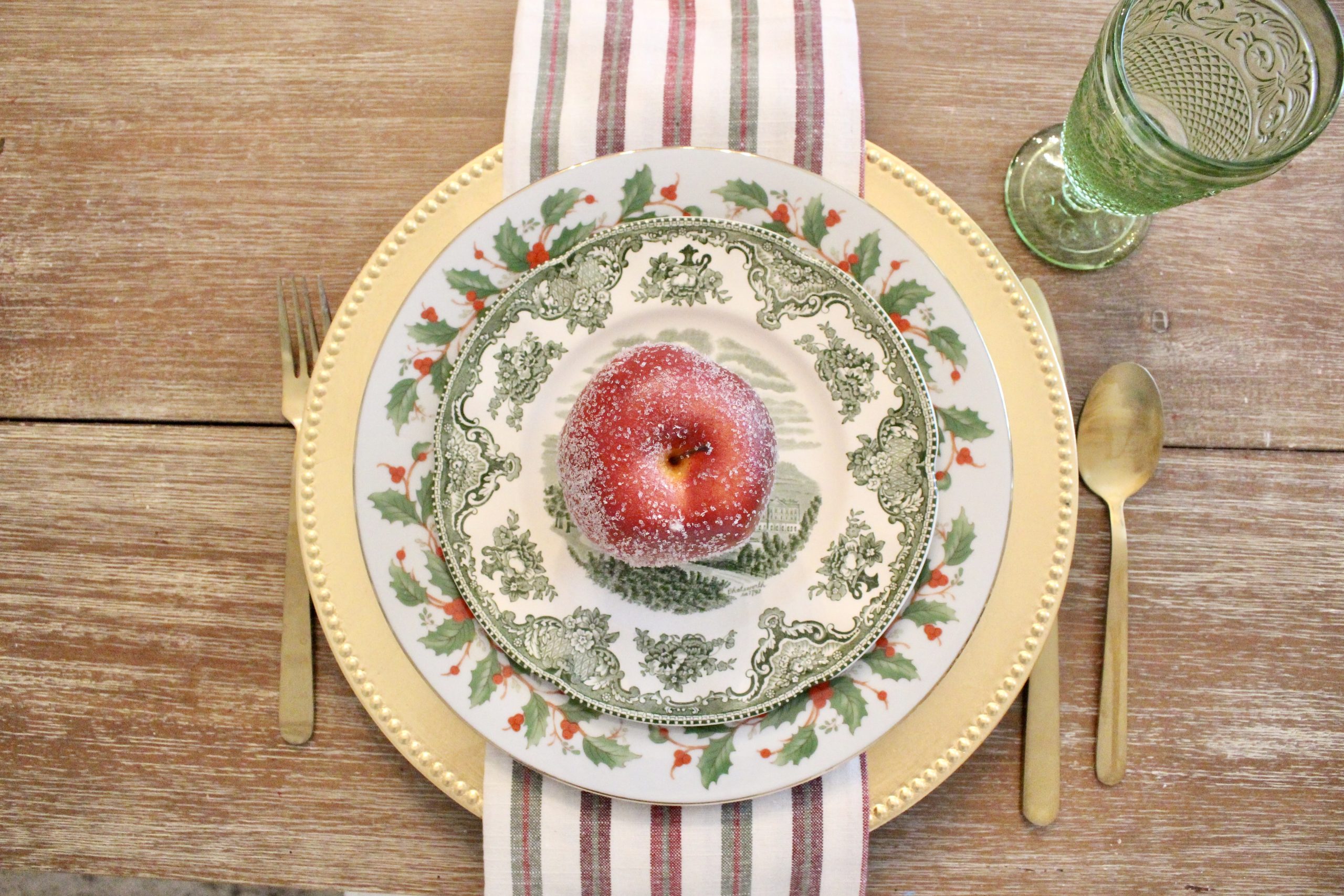
Thrifted glassware earns its place here too. Green goblets, in particular, are a genuinely easy find secondhand, and they photograph beautifully against a red and gold table. Etched glassware, whether bought or made yourself, adds another small layer of detail without adding another colour to keep track of.

A simple centrepiece trick worth knowing
Glittered or sugared fruit is one of the easiest ways to add a traditional, slightly old-fashioned touch to a table without buying anything new. A bowl of apples, pears and clementines dusted or dipped to give a frosted, glittery finish sits beautifully in the centre of a table or tucked among the place settings, and it costs next to nothing to put together with fruit you likely already have in.
It’s the kind of detail that looks like it came from a proper table styling shoot, but it’s genuinely a kitchen-table project that takes an afternoon.
Don’t forget the room around the table
A dining room at Christmas benefits from decoration beyond the table itself. Borrowing a few pieces from your mantel or elsewhere in the house, rather than buying an entirely separate set of dining room decorations, keeps the whole space feeling connected rather than like several different Christmases happening in different rooms.

Brass candlesticks in varying heights do a lot of work on a sideboard or mantel near the table. They catch candlelight beautifully, which matters more than almost anything else if you’re eating dinner in the evening, and a mismatched collection built up over time looks more interesting than a matching set bought all at once.
Make It Your Own
If you don’t have a vintage tablecloth, a plain cloth in a rich colour with a metallic-edged napkin in a contrasting shade gets you most of the way to the same layered look.
If you’re short on time, focus your effort on the table itself rather than the whole room. A well-set table with good lighting does more for the atmosphere than scattered decorations everywhere else.
If you want a lighter version of the look, swap the deep reds for a softer blush or dusty pink alongside the green and gold, which keeps the traditional feel but softens the overall palette.
If you’re hosting a big group, keep the centrepiece low. Tall arrangements look lovely in photos but make conversation across the table harder, and a low bowl of glittered fruit or greenery solves that problem while still looking festive.
Frequently Asked Questions
Red and green paired with gold accents are the classic traditional Christmas table colours, though warm brass, cream and deep burgundy all work well as supporting tones. The key is choosing rich, warm shades rather than bright primary versions of red and green.
Layer what you already own: a patterned plate over a plain charger, a mismatched set of glasses, and a good tablecloth or runner as the base. Most of the visual interest comes from layering and colour rather than from an expensive matching set.
It’s fresh fruit given a frosted, sparkling finish, usually by brushing it with a sugar syrup or egg white and rolling it in caster sugar, then leaving it to dry. It makes an inexpensive, traditional-looking centrepiece that lasts for the duration of a dinner party or gathering.
Charity shops, antiques fairs, and secondhand marketplaces are usually the best sources, and stock changes regularly enough that it’s worth checking back rather than expecting to find everything on one visit. Family hand-me-downs are also worth asking about, since vintage table linens were often better made than modern equivalents.
An odd number, usually three or five, at varying heights tends to look more natural than a single matching pair. Taller candlesticks at the ends with shorter ones filling the middle gives the table a sense of movement rather than a flat, symmetrical line.
Warm, low lighting from candles rather than overhead lights makes the biggest difference, along with a centrepiece kept low enough that it doesn’t block sightlines across the table. Metallic details like gold chargers and brass candlesticks catch candlelight particularly well.
Bringing it together
None of this needs to be bought new or planned months in advance. The best traditional Christmas tables tend to be built from things collected slowly over the years, layered with whatever secondhand finds turn up that season. Start with a good base, mix your tableware rather than matching it, and let a few small details, like the glittered fruit or the brass candlesticks, do the rest of the work.
If you’re planning the rest of your Christmas decorating, have a browse of the home interiors section for more room-by-room ideas.
Leave a Reply
If you like the sort of recommendation that still holds up six months later, leave your email below and I'll write to you on Sunday.
Most Sundays, once the house has gone quiet and it's edging towards nine, a letter goes out. It's the one I'd write to a friend with good taste and not nearly enough time: one thing worth reading, one thing worth buying, and one thing to skip. No noise, no pressure to spend, just the considered version of what I've actually been using, loving, or quietly sending back.