How to Start a Budget (When You Hate Spreadsheets)


Paying a mortgage that reset closer to 5% than the 2% you originally signed up for, watching a weekly grocery shop creep past £120, staring down an energy bill that still hasn't remembered the good old days: none of it feels like thriving. It feels like aggressive survival, and it feels that way even on a decent dual income. The Bank of England is holding the base rate at 3.75% and inflation is still sitting stubbornly above target, so if your money seems to evaporate by the 20th of the month, you are not doing anything wrong. The maths genuinely got harder.
Here is the reassuring bit. Learning how to start a budget is not about tracking every £3 flat white or feeling guilty every time you order a takeaway. A good budget runs in the background, it takes the panic out of the car MOT and the Christmas shop, and it clears enough mental space that you can spend on the things you actually love without that low hum of dread.
This guide walks through exactly how to do that, faff-free, using digital banking pots and a little automation rather than a colour-coded spreadsheet you will abandon by February.
The short version
To start a budget, work out your real take-home income, subtract your fixed non-negotiable costs, set money aside each month into separate “sinking fund” pots for irregular expenses like car repairs and Christmas, then give every remaining pound a deliberate job, including a proper amount for guilt-free spending. Automate as much as possible so the system runs itself.
That is the whole thing. Everything below is just the detail.
Step 1: Face the real numbers (your net income)
Most budgets fail at the very first line because people use the wrong figure. Your salary is not your budget. The number that matters is what actually lands in your account after tax, National Insurance, pension contributions and any student loan repayments have been taken off at source.
Log in and look at the real figure that hit your account last month. If you are self-employed or your income wobbles month to month, use the average of your last three months, or, to be safe, the lowest of the three.
For a household, add both take-home figures together. That single number is your ceiling. Everything you plan has to live underneath it, and there is something oddly calming about seeing it written down after years of guessing.
Step 2: The “non-negotiable” fixed costs
Next come the heavy lifters: the bills that leave whether you think about them or not. These are the costs that keep a roof up and the lights on, and they usually swallow more of your income than anyone likes to admit.
The usual suspects:
- Mortgage or rent
- Council tax
- Energy (gas and electricity)
- Water
- Broadband, mobile and any essential subscriptions
- Childcare or nursery fees
- Insurance (home, life, car)
- Minimum debt repayments (loans, credit cards, car finance)
A simple budget planner spreadsheet is genuinely useful for this one initial brain-dump, purely to see every fixed cost laid out in a single column. The free, government-backed MoneyHelper budget planner is a lovely place to do exactly that, and it costs nothing.
The goal, though, is to move past the spreadsheet quickly. A spreadsheet is a snapshot; it does not stop you overspending on a wet Tuesday. The system that follows is what actually holds.
Step 3: Set up sinking funds for the “faff”
Here is the single change that quietly transformed how our household money feels, and the reason “unexpected” bills stopped being a crisis.
A sinking fund is money you set aside a little at a time for a cost you know is coming, even if you do not know the exact date. The car will need tyres. Christmas arrives, astonishingly, in December. The boiler service is annual. None of these are surprises. They only feel like surprises because most of us try to absorb them out of one month's pay.
The trick is to divide the annual cost by twelve and move that amount into a dedicated pot every payday. Most modern UK banking apps let you create these pots or “spaces” in seconds, and you can name them whatever you like.
The pots worth having:
- Car (MOT, service, tyres, tax, the inevitable warning light)
- Christmas and gifts (birthdays included, so December never mugs you)
- Home and renovation (for the slow, considered projects, and the day the washing machine gives up)
- Holidays
- Annual bills (insurance renewals, TV licence, professional memberships)
- Rainy day (your genuine emergency buffer)
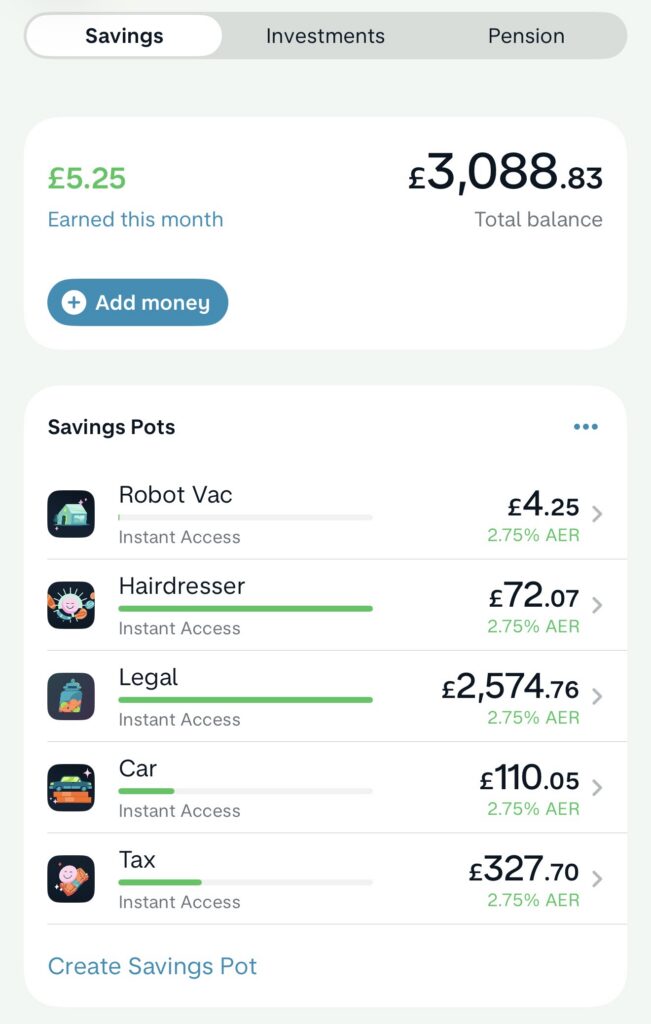
Picture roughly what this looks like in practice: a phone screen with neat little pots, each labelled and quietly filling. When the MOT bill arrives, you do not flinch. You just pay it from the car pot, because past-you already sorted it. That, more than anything, is the everyday luxury this whole vertical is built on. Not a bigger income. Just calm.
Step 4: The “everyday luxury” fun money
Now for the part every joyless finance article skips. A budget that leaves no room for pleasure is a diet, and diets fail. If your plan does not include the £45 serum you love, the good coffee, or the Friday night takeaway, you will resent it and quietly abandon it within a fortnight.
So build the joy in on purpose. Decide on a specific, ring-fenced amount for guilt-free spending each month, and then spend it without a second thought. That is the whole point of doing the work above: the pleasure is planned, so it comes without guilt.
This is where a concept called zero-based budgeting earns its keep, and it is far less intimidating than it sounds. Zero-based budgeting simply means giving every single pound a job before the month begins, so that your income minus all your assignments equals zero. Fixed costs get a job. Sinking funds get a job. Savings get a job. And crucially, your fun money gets a job too.
Nothing is left floating around unnamed, which is exactly the money that tends to disappear into nowhere by month's end. Every pound is accounted for, including the enjoyable ones. The clarity is the luxury.
Step 5: Give every leftover pound a destination (saving and investing)
Zero-based budgeting only holds if the leftover money has a job too. Once your fixed costs, sinking funds and fun money are all handled, whatever remains is not spare money; it is future-you's money. Left drifting in your current account, it quietly gets spent, so it needs a deliberate home just like everything else.
There is a sensible order to this, and following it removes most of the second-guessing. It runs roughly like so:
- Clear expensive debt first. Anything charging high interest, credit cards especially, works against you every month it sits there. Clearing it is usually the single most useful thing you can do with spare money.
- Build your emergency buffer. Three to six months of essential outgoings, held somewhere instant-access, so a broken boiler or a change in work does not turn into a crisis.
- Then think longer term. Only once that buffer is solid does money you will not need for years belong in a longer-term home.
Short-term savings, like the emergency fund or next year's holiday, want to be safe and reachable, which usually means a straightforward easy-access or fixed savings account. Money you genuinely will not touch for five years or more is where longer-term options such as a pension or a Stocks and Shares ISA come in, both of which are simply tax-efficient wrappers rather than investments in themselves.
Where your money should actually go depends entirely on your own circumstances, goals and timescale, so this is the moment to read the impartial, official guidance at MoneyHelper, or to speak to a regulated financial adviser if the sums are significant. The point of this step is not to tell you what to buy. It is simply to make sure the money your budget frees up is working somewhere on purpose, rather than evaporating by accident.
The best UK budgeting apps to automate it all
You do not need an app to budget. Plenty of people run the whole thing beautifully from their current account. But the right app removes the manual tracking burden, and for a tired brain at 9pm, that reduction in mental load is worth a great deal.
Thanks to Open Banking, UK apps can read your transactions directly, in pounds, with your permission, so nothing has to be typed in by hand. A quick, honest lay of the land:
Best for an all-accounts overview: Emma or Snoop. Both use secure, FCA-regulated Open Banking to pull every account into one view, categorise your spending automatically and flag subscriptions you have forgotten about. Emma has a capable free tier with a couple of accounts, then paid plans if you want more. Snoop leans into gentle nudges and savings suggestions. Either is a sound starting point.
Best for pot-based sinking funds: Monzo or Starling. If you would rather keep it simple, a current account with built-in pots lets you run every sinking fund from step three inside your actual bank, with round-ups and salary sorting to fill them automatically. The honest caveat: these only see money held with that bank, so they work best when most of your money lives in one place. I use Monzo for my every day current account, and their pots feature for sinking funds. (and yes, I'm rounding up my pennies because I dream of one day having a robot mop vac haha)
Best for committed zero-based budgeting: YNAB. For anyone who wants to go all in on giving every pound a job, YNAB is the established name and the method genuinely works. Two things to weigh, though: it is billed in US dollars so you absorb the exchange rate, and its bank sync has historically been patchier for UK accounts than the home-grown apps.
Pick one. Resist the urge to download all three. The best budgeting app is simply the one you will actually open.
What to do if the numbers don't balance
Sometimes you do all of this and the sum comes out red. The income is real, the costs are real, and there is a gap. This is the messy middle, and it is far more common than the tidy money accounts online would have you believe.
Before you make any painful lifestyle cuts, do the boring audit first, because it usually finds more than you expect.
- Scroll through your direct debits and standing orders. Every one of them. The gym you visited twice, the streaming service nobody watches, the app subscription that renewed at £9.99 without a whisper.
- Check for duplicate cover. Phone insurance you already have through your bank account, breakdown cover doubled up, that sort of thing.
- Look at the trio of energy, broadband and mobile. Out-of-contract prices quietly balloon. A ten-minute renewal or switch often claws back more than a month of skipped coffees ever would.
Only once you have wrung out the painless savings should you look at the harder choices. Nine times out of ten, the boring audit closes most of the gap on its own, and you get to keep the serum.
Budgeting FAQs
Start with one month's real take-home pay, list your fixed costs, set up two or three sinking fund pots for irregular expenses, and give the rest a deliberate job. Do not aim for perfect. Aim for started, then adjust next month.
It is a simple guideline suggesting roughly 50% of your take-home pay goes to needs, 30% to wants, and 20% to savings and debt repayment. It is a helpful starting shape, though many UK households with high fixed costs find the “needs” slice runs well over 50%, and that is fine. Use it as a compass, not a rule.
Sinking funds are small, regular amounts set aside for known future costs like car repairs, Christmas or annual insurance, so the bill is already covered when it lands rather than blowing a hole in one month's budget.
Reputable UK budgeting apps connect through FCA-regulated Open Banking, which gives them read-only access to your transactions in an encrypted, permission-based way. They cannot move your money. Always check an app is FCA-regulated before you connect an account.
A common guideline is three to six months of essential outgoings, but do not let that number paralyse you. A first buffer of £500 to £1,000 already softens most of life's smaller shocks, and you build from there.
Where to go next
Starting is the hard part, and if you have read this far, you are already most of the way there. A budget is not a one-off event; it is a small monthly habit that gets quicker every time, until one day you realise the money admin that used to sit on your chest has more or less handled itself.
You can find every money guide gathered together over in the money section.
And if you would like the occasional considered note on managing a home, a budget and a life that still feels like yours, the Sunday Letter lands gently in your inbox once a week. No spreadsheets required.
A quick, honest note: this guide is general information to help you think through your own money, not personalised financial advice. Some links above are affiliate links, which means the blog may earn a small commission at no extra cost to you if you sign up. Everything recommended here is something used and rated firsthand.
Leave a Reply
The Sunday Letter
Most Sundays, once the house has gone quiet and it's edging towards nine, a letter goes out. It's the one I'd write to a friend with good taste and not nearly enough time: one thing worth reading, one thing worth buying, and one thing to skip. No noise, no pressure to spend, just the considered version of what I've actually been using, loving, or quietly sending back.
If you like the sort of recommendation that still holds up six months later, leave your email below and I'll write to you on Sunday.