I'm Gillian, a Scotland based home & lifestyle blogger. Follow along as I navigate this new journey sharing my life from home.


When my parter moved in, he brought his Dedica EC685 with him. That was a year and a half ago now (and he owned for for a year and a half prior to that). The machine still lives on the worktop in the utility, tucked between the air fryer and ttoaster, and we still use it every single morning. Which is more than I can say for most of our appliances.
So here’s my proper DeLonghi Dedica EC685 review. Not a list of specifications, because you can get those from Currys. More like what it’s actually like to own one, what nobody tells you before you buy it, and whether a machine that’s been around for years is still the one to get in 2026.
Short answer: yes. Longer answer below, including the bits that irritate me.
Why this one, out of all of them
I’ll be honest about my priorities, because they might not be yours.
The machine is slim, it doesn’t take up half the counter space. We need something that can fit in a small utility room and not take up all the space. And we like coffee that tastes like coffee, not like a pod.
The Dedica is 15cm wide. That’s it. Narrower than most kettles. When people say they haven’t got room for an espresso machine, this is the one I point at, because I promise you have got 15cm somewhere.
The EC685M is the silver one. Brushed stainless steel front, proper metal, not the shiny plastic that goes slightly yellow after eighteen months. It looks far more expensive than it is, which is my favourite quality in an object.
It comes in black, white and red too (and sometimes even pink). The silver is the one that’ll go with whatever you do to your kitchen next.

The boring bit, very quickly
If you want the numbers before we get into it:
| Width | 149mm, so about 15cm |
| Pressure | 15 bar |
| Water tank | Around a litre, slides out the back |
| Portafilter | 51mm |
| Takes | Ground coffee or ESE pods |
| Milk | Manual steam wand |
| Price | Usually £129 to £149 on offer |
Right. Moving on.
What it’s like to actually use
It heats up in about thirty seconds. I cannot overstate how much this matters first thing in the morning. There’s no standing about waiting for a boiler to come up to temperature, no ten minute warm up. You press the button, you fill the basket, and by the time you’ve locked the handle in place it’s ready.
Locking the handle in is the good bit, by the way. There’s a satisfying clunk. Small pleasures.
The coffee that comes out, straight from the box with the baskets it gives you, is lovely. Thick, dark, a proper layer of crema on top. It’s forgiving, which is what you want at the start. You can use whatever ground coffee is in the cupboard, tamp it a bit wrong, and it’ll still give you something you’re happy to drink.
Is it what a good independent café would serve you? No, not out of the box. But it’s better than the chains, and it costs you about 30p a cup.
The drip tray, which sounds dull and isn’t
This is the thing that makes the 685 worth having over the older model, and it’s such a small design change that it barely gets mentioned.
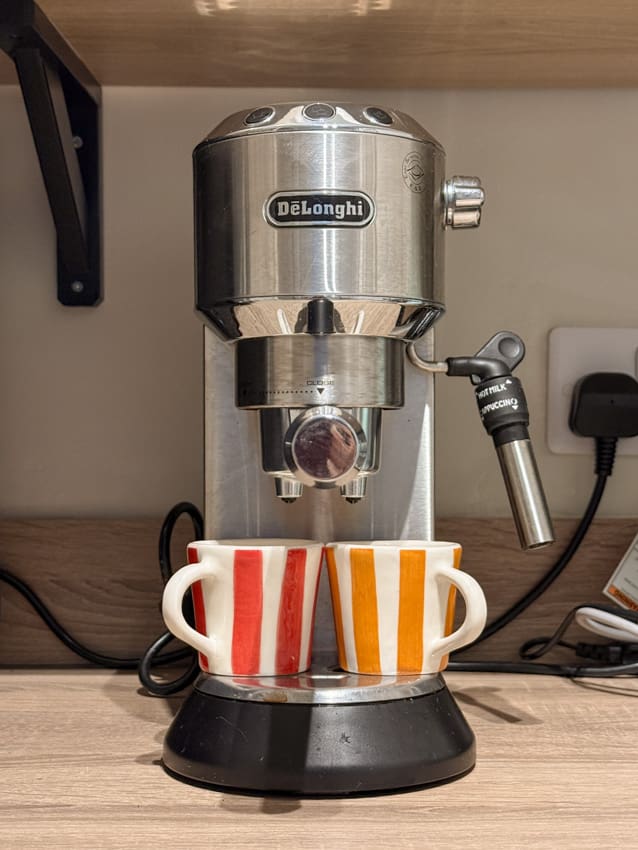
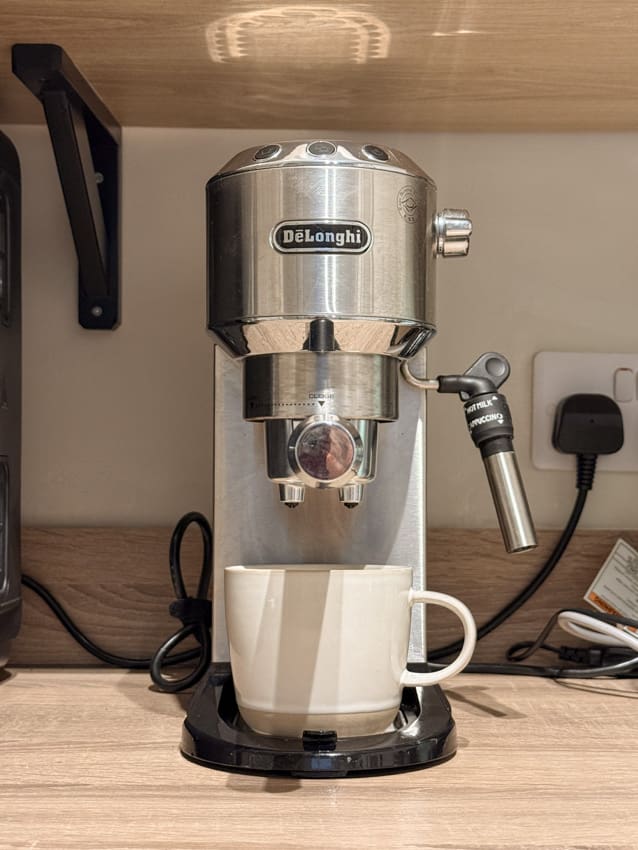
The drip tray moves. It sits high, so your little espresso cup is right up under the spouts and the coffee doesn’t have to fall three inches into the bottom of a glass. Or you pull out, and you can brew straight into a big mug. Or a travel cup.
I know. Riveting. But if you drink your coffee out of a proper mug, which is most of us, this is the difference between a machine you love and a machine that mildly annoys you twice a day for five years.
The old EC680 couldn’t do it and people were furious about it, which tells you everything.
The milk wand, and my one real complaint
The steam wand has a plastic sleeve on it with a little collar that slides up and down. Push it down and you get thick, cloudy, cappuccino foam. Slide it up and the milk comes out denser and flatter, which is what you want for a latte or a flat white.
For everyday purposes this is completely fine. It’s fast, it gets the milk properly hot, and you don’t need any skill whatsoever. My milk froths beautifully on the lower setting and I have never once thought about it.
But. If you’ve been watching people pour hearts and tulips on Instagram and you fancy having a go, this wand will break your heart. It aerates the milk for you rather than letting you swirl it yourself, so you get foam rather than that glossy, wet-paint texture you need for latte art. You can get close if you pull the plastic sleeve off entirely, and plenty of people do, but it’s fiddly.
If latte art is your actual goal, skip to the EC885 bit below. If you just want a nice milky coffee, you’ll never notice.
One thing though: wipe the wand the second you finish with it, and give it a blast of steam to clear it. Every couple of weeks slide the sleeve off and let it soak in hot soapy water. Dried milk is what kills these wands, and it happens quicker than you’d think.
Should you get the Arte EC885 instead?
This is the question I get asked most, so let me save you some time.
The Dedica Arte EC885 is the newer, pricier version. Same insides. Same coffee. The espresso that comes out is essentially identical, and anyone who tells you different is selling something.
What you’re actually paying the extra for is the milk wand. The Arte gets a proper metal one, the kind you’d see in a café, with no plastic sleeve. It’s a genuinely better piece of kit and it means you can learn to texture milk properly. It also comes with a metal tamper and a milk jug in the box, where the 685 gives you a plastic scoop thing that you’ll want to replace immediately.
So: if you’re dreaming about latte art, get the Arte and don’t look back. If you drink espresso, americanos, or milky coffee where you care that it’s hot and tastes good rather than how the foam sits, save the £60 to £100 and get the 685.
Honestly? If it were my money and I wasn’t fussed about latte art, I’d buy the 685 and spend the difference on better beans. That’ll do more for your coffee than the wand will.
A quick word on the Smeg
You know the Smeg espresso machine. The retro one, in the pastel colours, that looks like it belongs in a film set in 1954.
Here’s a fun thing almost nobody realises: underneath, it’s near enough a Dedica. Same 15 bar pump, same 51mm portafilter, the accessories mostly swap between them. What Smeg has done is put it in a much quirkier body and charge you roughly double.
The Smeg body is plastic. The Dedica’s is steel. The Smeg’s wand doesn’t adjust. The Dedica’s does.
I’m not going to pretend the Smeg isn’t gorgeous, because it really is, and if your kitchen is built around that aesthetic then buy the Smeg and enjoy it. Just know you’re paying for the shape, not the coffee.
The three things I’d actually buy for it
You’ll see endless lists of 51mm accessories for the Dedica. Most of it is clutter. These are the ones that changed something.
A non-pressurised basket. About a tenner. This is the one that matters. The baskets it comes with have a little hole in the bottom that fakes the crema, which is brilliant when you’re learning and limiting once you’re not. Swap it out, use fresh beans, and suddenly you’re tasting the actual coffee rather than a generic espresso flavour. It takes a week of faffing to get your grind right and then you’ll never go back.
A proper metal tamper. The plastic one in the box is not good. A weighted 51mm steel tamper is about £15 and it makes your coffee more consistent day to day, which is the whole battle really.
A bottomless portafilter. Around £25, usually with a wooden handle, and they’re beautiful. But the reason to get one isn’t that it photographs well (although it does). It’s that with no spouts in the way you can see exactly what your coffee is doing. If it’s squirting out one side, your tamp is wonky. It teaches you more in a fortnight than any amount of reading.
There’s also a whole world of people swapping the wand out for a Rancilio Silvia one, which turns the 685 into most of an EC885. It voids your warranty and involves actual tools, so I’ll leave that with you (I would personally just buy the EC885 model, it probably costs the same as the wand swap).
What I don’t love
No machine at this price is perfect, so here’s the honest list.
You can’t make an espresso straight after steaming milk. The machine runs too hot, so you have to run water through it to cool it down first. Making two milky coffees back to back for a friend is a slightly awkward little dance.
It drips. Always a bit of water after the shot. That’s what the tray’s for, but you can’t leave a cup sitting under it.
Two mugs at once is optimistic. It technically does two, but the gap. You could maybe fit 2 espresso cups under it together. Maybe.
And the water tank slides out the back, so if your machine sits against a wall you’ll be shuffling it forward every couple of days. Minor, but you’ll notice it.

The questions everyone asks
It wants descaling. That’s almost always what it means. It’s on a counter, so it’ll go off after a certain number of coffees whether or not your water is actually that hard.
Fill the tank with descaler and water, following the packet. Turn it on, wait for the lights to settle, then hold the descale button for about ten seconds until they start flashing in sequence. Then follow it through, turning the steam dial to send the solution out of the wand and closing it to push it through the coffee spouts.
When the tank’s empty, rinse it properly, fill it with clean water and run the whole rinse cycle. Takes about half an hour start to finish.
Do not skip the rinse. I promise you it’s tempting and I promise you it’s the reason the light comes back.
Every two to three months in a hard water area, every four to six in a soft one. If you’re in Scotland like me, your water is soft, so you can relax a bit.
Nine times out of ten it’s because the cycle didn’t get finished all the way through the rinse. Start again and let it run to the end.
While you’re in there, check your water hardness setting. If it thinks you’re in a hard water area and you’re not, it’ll nag you constantly for no reason.
Hold the descale button for about ten seconds and you’ll get into the settings menu, where you can set water hardness, turn the coffee temperature up, and put everything back to factory settings. You’ll know the reset has taken because all three lights flash together at once.
Worth keeping the little booklet somewhere findable, because the exact buttons vary slightly by model. And be aware a reset wipes your programmed cup sizes, so you’ll need to set those again by holding the one or two cup button until it’s poured as much as you want.
Descale it and wipe the wand and you’ll get years out of it. Loads of people are still running the same machine after five or six. Neglect the descaling and limescale will finish it off, and it’s not worth repairing when it does. That really is the only thing that kills them.
More than ever, I’d say. It’s been replaced by a newer model, which means it gets discounted properly, and the coffee it makes is the same. Buying the slightly older version of something good, at a lower price, is my favourite kind of purchase.
So, would I buy it again?
Yes. Immediately.
Not because it’s the best espresso machine in the world, because it isn’t and it doesn’t pretend to be. But because it’s the one that made good coffee a normal part of my day rather than a thing I go out for.
It’s a few minutes in the morning where I’m not looking at my phone. Filling the basket, the clunk of the handle, half a minute of noise, and then a decent coffee in a nice cup before the day starts making demands. For something that cost less than a weekend away and takes up 15cm, that’s a very good deal.
If it’s your first espresso machine and you want something that won’t overwhelm you or take over your kitchen, this is still the one I’d tell you to get.
If you are looking for more reviews or write-ups on home gadgets, you can check out the tech hub.
Leave a Reply
If you like the sort of recommendation that still holds up six months later, leave your email below and I'll write to you on Sunday.
Most Sundays, once the house has gone quiet and it's edging towards nine, a letter goes out. It's the one I'd write to a friend with good taste and not nearly enough time: one thing worth reading, one thing worth buying, and one thing to skip. No noise, no pressure to spend, just the considered version of what I've actually been using, loving, or quietly sending back.